
A Guide to Adaptive Hiking Gear and Techniques
Reprint from Assistive Sports Technology; article written by angelonelo
Introduction: The Outdoors Belongs to Everyone
There’s a particular kind of quiet you only find on a trail. The crunch of gravel underfoot, the way sunlight filters through a canopy of Douglas firs, the strange and satisfying ache in your legs after a long climb. For decades, that experience was treated as a privilege something implicitly reserved for those who could walk unaided, carry a heavy pack, and navigate uneven terrain without a second thought. That assumption, thankfully, is being dismantled one switchback at a time.
Adaptive hiking has emerged as one of the most quietly revolutionary movements in outdoor recreation. Whether you’re managing a mobility impairment, supporting a family member with a disability, hiking with someone on the autism spectrum, or simply getting back on the trail after an injury, the right adaptive hiking gear and the right mindset can completely rewrite what’s possible. And what’s possible, it turns out, is a lot.
This guide covers everything the equipment, the techniques, the programs, and the resources, so you can get out there with confidence.
What Is Adaptive Hiking? Understanding the Basics
Adaptive hiking refers to modified hiking practices and specialized equipment designed to make trail experiences accessible to people with a wide range of physical, cognitive, or sensory disabilities. It’s not a watered-down version of hiking. It’s hiking full stop executed with smarter tools and more thoughtful planning.
The term “adaptive” is key here. Rather than asking a person to conform to the demands of the trail, adaptive hiking adapts the trail experience through gear, technique, and program design to meet the individual where they are.
According to GoGrit Adaptive Hiking, adaptive hiking encompasses everything from guided outings for wheelchair users to sensory-friendly hikes designed for individuals with autism. The goal is the same as any hike: to connect with nature, challenge yourself, and come home with a story worth telling.
Who Benefits from Adaptive Hiking?
The short answer: far more people than you might think. Consider that, according to the CDC, roughly 1 in 4 adults in the United States lives with some form of disability. In Canada and the UK, similar statistics hold. That’s an enormous community that has historically been underserved by mainstream outdoor recreation.
Adaptive hiking serves:
- People with mobility impairments — including those who use wheelchairs, prosthetics, or walking aids
- Individuals with visual or hearing impairments
- Veterans with physical or psychological injuries
- People with autism spectrum disorder (ASD)
- Older adults experiencing age-related mobility changes
- Individuals recovering from surgery, stroke, or chronic illness
What Are Two Types of Adaptive Equipment? Breaking Down the Categories
When people ask “what are two types of adaptive equipment?”, the answer depends on context — but broadly, adaptive equipment for hiking falls into two primary categories: mobility aids and sensory or cognitive support tools.
- Mobility Aids
These are the workhorses of adaptive hiking gear. They’re designed to extend or replace physical function, helping users navigate terrain that would otherwise be inaccessible.
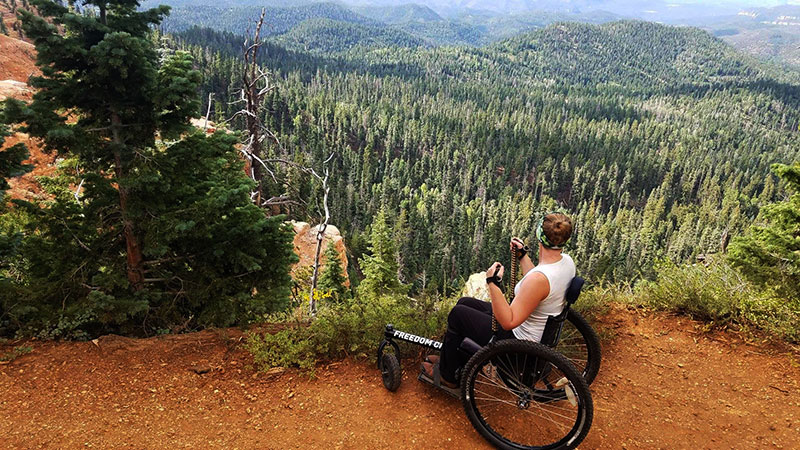
- All-terrain wheelchairs and beach/trail wheelchairs (e.g., the GRIT Freedom Chair, Joëlette)
- Forearm crutches and trekking poles with ergonomic grips
- Adaptive trekking poles with offset handles for people with limited grip strength
- Prosthetic limbs designed specifically for trail use
- Exoskeleton devices — an emerging technology for users with limited lower-body function
- Sensory and Cognitive Support Tools
Less visible but equally important, these tools help hikers with neurological, sensory, or cognitive differences navigate the trail safely and comfortably.
- Noise-canceling headphones or ear protection for sensory-sensitive hikers
- Visual schedules and trail maps in simplified formats for neurodiverse hikers
- Communication devices for non-verbal individuals
- GPS trackers and emergency communication devices (like the Garmin inReach)
- Weighted vests — used by some autistic hikers to provide proprioceptive feedback
Our Adaptive Hiking Gear Guide offers an excellent breakdown of both categories with detailed product recommendations.
What Are Adaptive Equipment for Disability? A Closer Look
The distinction between “adaptive” and “assistive” equipment comes up often, and it’s worth clarifying. Assistive devices help compensate for a lost or impaired function think hearing aids or standard wheelchairs. Adaptive equipment specifically modifies an activity so that someone can participate in it trail wheelchairs, adaptive ski gear, and ergonomic hiking poles all fall into this category.
For hiking, adaptive equipment for disability typically addresses one of three functional challenges:
| Challenge | Adaptive Solution |
| Lower limb mobility | All-terrain wheelchairs, prosthetic trail feet, forearm crutches |
| Upper body weakness | Lightweight trekking poles, chest harnesses, grip aids |
| Balance and coordination | Trekking poles, anti-fatigue footwear, stabilizing braces |
| Sensory sensitivity | Ear protection, UV-filtering eyewear, compression clothing |
| Cognitive navigation | GPS devices, visual trail guides, buddy systems |
| Fatigue and stamina | Electric assist trail chairs, rest-stop planning tools |
Is Adaptive Equipment Expensive?
Let’s be honest: high-quality adaptive gear can carry a premium price tag. A top-of-the-line all-terrain wheelchair like the GRIT Freedom Chair starts around $3,000–$5,000. Specialized prosthetic feet designed for trail use can cost even more.
That said, there are real pathways to affordable access:
- Non-profit loaner programs — Many adaptive hiking organizations lend equipment at no cost
- Veterans benefits — US veterans may qualify for adaptive gear through the VA
- State and provincial disability grants — In the UK, the Motability Scheme covers a range of mobility aids
- Crowdfunding and community resources — Organizations like Beyond Barriers Sports help connect individuals with funding options
If you’re a disabled person wondering “what can I get for free?”, the answer often depends on your location and specific disability classification, but it’s absolutely worth investigating the resources are out there, and they’re growing.
Adaptive Hiking Gear: The Essential Kit
Let’s get practical. Whether you’re outfitting yourself or a loved one for the first time, here’s what a well-considered adaptive hiking kit looks like.
Footwear and Lower-Body Support
Adaptive walking boots deserve special mention. Standard hiking boots are designed with a neurotypical, able-bodied foot in mind. Adaptive alternatives account for:
- Single-boot options — For amputees who need just one shoe
- Extra-wide toe boxes — For users with edema, AFOs (ankle-foot orthoses), or neuropathy
- Easy closure systems — Velcro and BOA dials for people with limited hand dexterity
- High-ankle support — For users with ankle instability or proprioception issues
Brands like Altra, Keen, and Merrell offer adaptive-friendly designs, while specialized companies like Kuru and Apis cater more directly to orthotic needs.
Trekking Poles and Walking Aids
If mobility aids were ranked by bang-for-buck, trekking poles would sit at the top. A quality pair reduces impact on the knees by up to 25%, improves balance on uneven terrain, and for many adaptive hikers replaces the need for more expensive equipment.
For adaptive hikers, look for:
- Ergonomic or angled grips — Reduces wrist strain for users with arthritis or limited grip
- Adjustable length — Essential for hikers using a prosthetic limb on one side
- Shock-absorbing tips — Reduces vibration transmitted to joints
- Forearm (Lofstrand) crutches converted to poles — A cost-effective solution many adaptive hikers swear by
All-Terrain Wheelchairs and Trail Chairs
This is where the technology has made the most dramatic leaps in recent years. The old image of a wheelchair rigid, narrow, suitable only for smooth indoor surfaces has little in common with today’s trail-ready options.
| Chair Type | Best For | Approx. Cost (USD) |
| GRIT Freedom Chair | Independent trail use, moderate terrain | $3,000–$4,500 |
| Joëlette | Guided hikes, any terrain | $2,500–$4,000 |
| Beach/Trail Rental Chair | Occasional users, budget-conscious | Free–$100/day |
| Power-Assist Chairs | Users who need propulsion help | $5,000–$10,000 |
Many national parks and trail systems in the US, Canada, and UK offer trail chair rentals more on that in the programs section.
Packs and Carrying Systems
For wheelchair users and those with upper-body limitations, traditional backpacks can be impractical or impossible. Alternatives include:
- Lap bags and wheelchair-mounted storage
- Hip-carry packs — For amputees or users who can’t bear shoulder weight
- Chest-mount hydration systems — Keep water accessible without removing a pack
- Caregiver-worn packs — For guided hikes where a companion carries shared gear
How to Choose Adaptive Equipment: A Practical Framework
Choosing the right adaptive gear isn’t a one-size-fits-all exercise. Here’s a simple framework:
Step 1: Identify the specific barrier. Is it mobility? Endurance? Sensory overwhelm? Navigation? Start with the clearest problem.
Step 2: Consult a professional. Occupational therapists and physical therapists who specialize in adaptive recreation can assess your needs far more accurately than a gear catalog.
Step 3: Try before you buy. Many adaptive recreation organizations offer demo days and equipment trials. Take full advantage.
Step 4: Consider the terrain. An all-terrain chair that handles rocky mountain trails might be overkill for flat, paved nature paths. Match the gear to the actual trails you’ll be using.
Step 5: Factor in independence vs. supported hiking. Some adaptive gear requires a guide or companion. If independent hiking is a priority, weight that heavily in your decision.
Adaptive Hiking for Autism: A Thoughtful Approach
Hiking with someone on the autism spectrum or hiking as an autistic person introduces considerations that go beyond physical gear. The sensory environment of a trail can be both a gift and a challenge.
What Makes Trails ASD-Friendly?
- Lower foot traffic — Less auditory and social overwhelm
- Predictable terrain — Loops or out-and-back trails with clear endpoints
- Access to shade — Reduces sensory overload from heat and light
- Minimal wildlife sounds — For some, unexpected loud sounds trigger distress
Adaptive Equipment for Autism on the Trail
The right gear for an autistic hiker is less about mobility aids and more about sensory management:
- Noise-canceling earbuds or ear defenders — The single most impactful tool for many sensory-sensitive hikers
- Weighted backpacks — Provide calming proprioceptive input
- Fidget tools and comfort objects — Carried in an easily accessible pocket
- Communication cards or apps — For non-speaking individuals hiking in groups
- Sunglasses with UV protection — Reduces visual glare and sensitivity
The social dimension matters, too. Many autistic hikers thrive in small, predictable group structures led by guides familiar with ASD. Programs like those offered through adaptive adventure organizations specifically train guides in neurodiversity-informed facilitation.
Adaptive Hiking Programs and Access Points: US, Canada, and UK
Knowing the gear is only half the equation. Knowing where to go and who can help you get there is equally important.
United States
The US has some of the most robust adaptive hiking infrastructure in the world, driven in part by the Americans with Disabilities Act (ADA) and decades of advocacy.
- Massachusetts Adaptive Hiking Programs — The Massachusetts DCR offers guided adaptive hikes, equipment loans, and accessible trail maps across the state.
- Texas State Parks — Texas has expanded accessible trail options dramatically, with beach wheelchairs available at coastal parks and paved accessible routes in many inland parks.
- National Park Service — Most US national parks now offer all-terrain wheelchairs for loan at no charge, often through the America the Beautiful Access Pass for eligible individuals.
Canada
Canada’s national and provincial parks have invested significantly in adaptive access:
- Parks Canada — Offers accessibility guides for each national park and has expanded all-terrain wheelchair loaner programs at several sites
- BC Parks and Ontario Parks — Both have designated accessible trails with surface ratings and grade information
United Kingdom
- Fieldfare Trust — Produces the BT Countryside for All standards and provides guidance on accessible countryside design
- Disabled Ramblers — A UK-based organization specifically dedicated to adaptive hiking, offering group outings and equipment guidance
- National Trust and Forestry England — Both organizations have invested in accessible trail infrastructure and provide detailed accessibility information for their properties
What Is the Most Disability-Friendly Country?
It’s a question worth asking. While ranking is subjective, countries like Sweden, Germany, and Australia consistently rate highly for disability-inclusive outdoor infrastructure. Within the English-speaking world, the US leads in program variety, Canada excels in accessible wilderness, and the UK offers excellent urban-adjacent trail access. The honest answer: every country has gaps, and advocacy is ongoing.
The Health Benefits of Hiking — For Everyone
Does hiking lower cholesterol? Can it support cardiovascular health for people with disabilities? The research says yes, with meaningful caveats.
Hiking even at a slow pace or in an adaptive format delivers measurable physical benefits:
- Cardiovascular improvement — Studies show even moderate trail walking improves heart health markers, including LDL cholesterol levels
- Mental health gains — Nature exposure reduces cortisol levels and symptoms of depression and anxiety
- Bone density — Weight-bearing activity, even partial, supports bone health
- Social connection — Group adaptive hikes reduce isolation, a significant issue in many disability communities
The key is that “adaptive” doesn’t mean “less effective.” A guided Joëlette hike through a mountain forest delivers real physiological and psychological benefit comparable, in many respects, to an unaided hike at the same pace.
Frequently Asked Questions About Adaptive Hiking Gear
What are the adaptive devices for walking? The main categories include trekking poles, forearm crutches, walking frames, AFOs (ankle-foot orthoses), prosthetic limbs, and all-terrain wheelchairs. Each serves a different functional need and level of mobility.
What is another name for adaptive equipment? Adaptive equipment is also commonly called assistive technology (AT), compensatory devices, or rehabilitation equipment, depending on the clinical context.
Who needs adaptive equipment? Anyone whose mobility, sensory processing, or cognitive function creates barriers to standard activity participation. This includes people with congenital disabilities, acquired injuries, progressive conditions like MS or ALS, and older adults experiencing age-related changes.
What is the difference between adaptive and assistive devices? Assistive devices compensate for a deficit (e.g., a hearing aid restores hearing function). Adaptive devices modify an activity to enable participation despite a deficit (e.g., a trail wheelchair modifies hiking so a non-ambulatory person can participate). The distinction blurs in practice, and the terms are often used interchangeably.
What are three assistive devices for hiking?
- Trekking poles — balance and stability
- All-terrain wheelchairs — trail mobility for wheelchair users
- GPS communication devices (like Garmin inReach) — safety and navigation
How do I choose adaptive hiking equipment? Start by identifying your specific functional barriers, consult an occupational therapist or adaptive recreation specialist, try equipment before purchasing, and match your gear to the terrain you’ll actually be hiking. For more detailed guidance, Our adaptive gear guide is an excellent starting resource.
Adaptive Hiking Tips: Getting the Most from Your Trail Experience
You have the gear. Here’s how to make the most of it.
Start with accessible trails and build up. Don’t begin with a black-diamond scramble. Accessible trails are those with firm, stable surfaces, manageable grades, and rest areas are the foundation. Once you’ve calibrated your gear and your body, expand.
Tell someone your plan. This applies to every hiker, but especially adaptive hikers venturing into less-trafficked areas. Share your route, your expected return time, and emergency contacts.
Respect the “spoon theory” principle. Many adaptive hikers live with conditions that affect energy levels unpredictably. Budget energy conservatively and build in more rest than you think you’ll need on your first outings.
Connect with a community. Organizations like GoGrit and Beyond Barriers Sports don’t just provide gear guidance — they connect you with communities of adaptive hikers who share route recommendations, gear hacks, and hard-won wisdom.
Advocate for the trails you want. The growth of adaptive hiking infrastructure depends on demand signals. Use accessible trail options, leave reviews, contact park services, and support organizations working toward greater trail access.
Conclusion: The Trail Is Calling — Answer It
Somewhere between the first click of a trekking pole and the moment you clear a ridgeline to find a view that stops time, something shifts. It stops being about the gear, the disability, the logistics. It becomes what hiking has always been: you, the landscape, and the particular freedom of being somewhere wild.
The adaptive hiking movement has made that experience available to more people than ever before and it’s not slowing down. New technology, expanding programs, and a growing community of advocates are pushing the boundaries of what accessible outdoor recreation looks like across the US, Canada, and the UK.
Your next step is simple: identify one trail near you with an accessibility rating, one piece of adaptive gear that addresses your primary barrier, and one organization local or national whose programs you can explore. The rest follows.
Because the outdoors doesn’t belong to a subset of people. It never did.